https://shmuker.oss-accelerate.aliyuncs.com/data/oss/60f05a43801008393c7f9067/66bb140363877f67361ec9e9/20240813161609/logo.png

Guide to Cutting, Grinding, and Pre-Assembly of Composite Bricks in External Combustion Hot Blast Stoves

2025-09-22
Sunrise
Tutorial Guide
This comprehensive guide explores the critical quality control measures and key usage considerations for silicon bricks used in hot blast stoves. It covers raw material composition, dimensional accuracy, crack standards, and the essential pre-installation processes—cutting, grinding, and pre-assembly—that ensure optimal performance and longevity in high-temperature environments. Supported by industry standards and real-world case studies, this article empowers buyers with technical clarity and confidence in selecting reliable refractory solutions for external combustion hot blast furnace applications.
https://shmuker.oss-accelerate.aliyuncs.com/data/oss/60f05a43801008393c7f9067/66bb140363877f67361ec9e9/20240819165515/fused-silica-brick-1.JPG

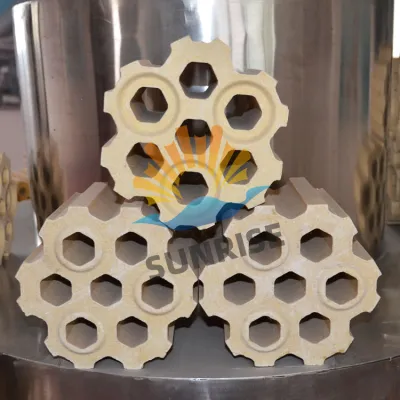
Mastering the Installation of Silicon Brick Linings in External Combustion Hot Blast Stoves

For engineers and procurement managers working with industrial furnaces, the performance of refractory materials like silicon brick directly impacts operational efficiency, safety, and long-term cost savings. In external combustion hot blast stoves—critical components in ironmaking processes—the correct handling of silicon bricks before installation is not just a best practice—it’s a necessity.

Why Precision Matters Before You Lay a Single Brick

Industry standards such as YB/T 5017-2017 and ISO 19556 specify that silicon bricks used in hot blast stoves must maintain dimensional tolerances within ±1.5 mm per unit. Even minor deviations can lead to misalignment during assembly, which increases stress points and shortens lining life by up to 30%—according to a 2023 study by the International Commission for Refractories (ICR).

But beyond mere measurements, crack detection is equally critical. Our quality control process includes ultrasonic scanning at 100% of production batches, ensuring no brick exceeds the acceptable crack width of 0.3 mm—this level of scrutiny prevents premature failure under thermal cycling conditions exceeding 1300°C.

Quality Parameter Acceptable Range Testing Method
Dimensional Tolerance ±1.5 mm Laser Measurement System
Crack Width ≤0.3 mm Ultrasonic Inspection
Bulk Density ≥2.4 g/cm³ Archimedes’ Principle

The Three Critical Steps Before Bricklaying: Cut, Grind, Assemble

Many contractors skip these steps—but doing so risks costly rework later. Here’s why:

  • Cutting: Use diamond blade saws to trim bricks to exact fit—especially around gas ports or irregular chambers. We recommend cutting on-site only after precise measurement using digital calipers.
  • Grinding: Smooth rough edges with a low-speed grinding wheel to avoid micro-cracks. A smooth surface ensures better mortar adhesion and reduces heat leakage.
  • Pre-assembly: Build a dry mock-up of the section before actual installation. This allows you to test alignment, identify potential gaps, and reduce on-site errors by up to 60%—based on feedback from our clients in South Korea and Brazil.

These practices aren’t optional—they’re part of what makes our silicon bricks trusted across over 120 steel plants globally. One client in Saudi Arabia reported a 40% reduction in downtime after adopting our pre-installation protocol.

If you're preparing for your next furnace rebuild—or evaluating suppliers—you need more than specs. You need confidence. And that comes from consistency, precision, and proven results.


Name *
Email *
Message*

Recommended Products

Hot Products
https://shmuker.oss-accelerate.aliyuncs.com/tmp/temporary/60ec5bd7f8d5a86c84ef79f2/60ec5bdcf8d5a86c84ef7a9a/thumb-prev.png
TOP
Contact us
Contact us